
Why Technology Gets Expensive When Nobody Owns Lifecycle Planning
- 3 days ago
- 4 min read
Most technology environments do not get expensive all at once.
They get expensive slowly, then suddenly.
A few laptops stay in service a little too long. A server replacement gets pushed to next year. Software renewals pile up without a clear owner. A printer contract quietly renews again. Security tools get added on top of old ones instead of replacing them. Nothing feels urgent on its own, but the environment gets harder to manage, less predictable to budget, and more frustrating for everyone who depends on it.
That is usually not a support problem. It is a leadership problem.
What lifecycle planning actually means
Lifecycle planning is the discipline of knowing what technology you have, where it stands, when it should be reviewed, and what needs to happen before it becomes a risk, a surprise, or an emergency purchase.
It is not just about replacing old hardware.
A good lifecycle plan should cover the pieces that quietly drive cost and operational drag over time:
devices and equipment
servers, network gear, and infrastructure
software renewals and licensing
vendor contracts and support coverage
warranty status and replacement timing
systems that are still working, but no longer make business sense
When this is owned well, leadership gets fewer surprises, teams get fewer fire drills, and budgets become much easier to manage.

Why organizations miss it
In a lot of growing organizations, nobody is deliberately ignoring lifecycle planning. It just falls into the gaps.
The helpdesk is busy keeping people running. The MSP is focused on tickets, projects, and contract scope. Leadership assumes someone has the bigger picture. Finance sees the invoices but not always the pattern behind them.
So the environment drifts.
The signs are usually easy to spot
You may have a lifecycle problem if any of this sounds familiar:
Aging devices stay in place until users start complaining. Critical infrastructure gets replaced only after it becomes unstable. Renewals show up too late for a thoughtful decision. Different locations or departments are on different standards. Budgets swing based on emergencies instead of a plan.
None of that means your team is failing.
It usually means the organization has support, but not enough ownership at the leadership level.
Where the real cost shows up
The obvious cost is replacement spending.
The less obvious cost is everything around it.
Emergency decisions cost more
When replacement timing is unclear, organizations buy under pressure. That usually means fewer options, weaker negotiation leverage, rushed implementation, and more disruption than necessary.
Old systems create hidden support costs
Even when outdated technology is still technically running, it often creates extra effort. It takes longer to troubleshoot, it behaves inconsistently, and it pulls staff toward recurring issues instead of better work.
Budgeting becomes reactive
Without a lifecycle view, IT spending looks unpredictable from the outside. Leaders see surprise asks instead of a structured plan. That makes it harder to trust future recommendations, even when the need is legitimate.
Standards break down over time
When equipment and software are replaced one-off, the environment gets harder to support. Different versions, different vendors, and different exceptions start to multiply. What looked like flexibility turns into operational friction.
What good lifecycle planning looks like
A mature lifecycle plan is not complicated for the sake of being complicated.
It is clear, usable, and tied to real decisions.
Start with visibility, but do not stop there
An asset list alone is not enough. Plenty of organizations have spreadsheets full of equipment and still make reactive decisions.
The real value comes from turning that information into leadership guidance.
A useful lifecycle view should answer questions like these
What is nearing end of life in the next 12 to 24 months?
What renewals deserve review before they auto-renew?
Which systems are costing more in support time than they are worth?
Where are standards drifting across teams, buildings, or departments?
What should be budgeted now, next quarter, and next year?
Those are business questions as much as technical ones.
Tie lifecycle planning to budgeting and priorities
This is where many environments improve quickly.
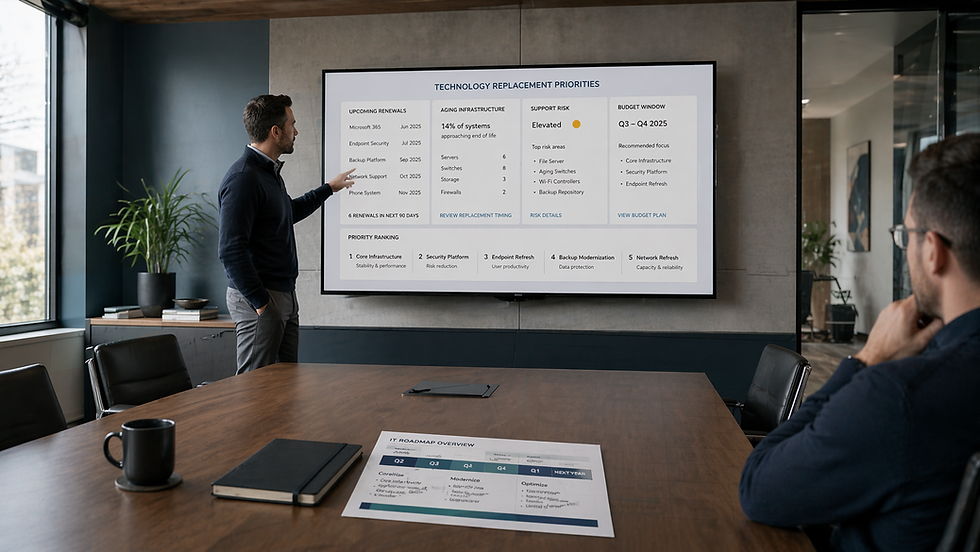
Once lifecycle planning is connected to budgeting, IT stops sounding like a series of interruptions and starts sounding like a managed function. Leadership can see what is urgent, what is predictable, what can wait, and what becomes more expensive if ignored.
That changes the conversation.
Instead of asking, “Why do we suddenly need this?” the better question becomes, “What is the right timing and priority for this?”
That is a much healthier place to operate from.
Keep ownership clear
This part matters more than most organizations realize.
A lifecycle plan does not stay useful unless someone owns it. Not just the list. Not just the renewals. The actual review process, the standards, the timing, and the connection to leadership decisions.
That ownership may come from an internal IT leader. In some environments, it comes from outside leadership support that helps bring structure around planning, vendors, budgeting, and priorities.
Either way, the key is the same: someone has to be responsible for keeping the bigger picture current.
The goal is not to replace everything sooner
Good lifecycle planning is not about creating more spending.
It is about creating better timing.
Sometimes the right answer is to replace something early because the risk is rising. Sometimes the right answer is to extend life because the business value is still there.
Sometimes the right answer is to standardize before buying anything else.
The point is not to force a refresh cycle for the sake of neatness.
The point is to make technology decisions on purpose.
Closing thoughts
A lot of organizations assume rising IT costs are just part of growth. Sometimes they are. But just as often, the real issue is that nobody is actively managing lifecycle decisions before they turn into budget problems, support problems, or leadership surprises.
When that starts to happen, it helps to step back and look at the environment with a little more structure. Not to overcomplicate it. Just to understand what is aging, what is drifting, what is coming, and what deserves a clearer plan. If that review shows gaps in ownership, budgeting, standards, or replacement timing, that is usually a good point to bring in outside perspective and get the environment moving in a more deliberate direction.


Comments